HackBarna AI Summit 26
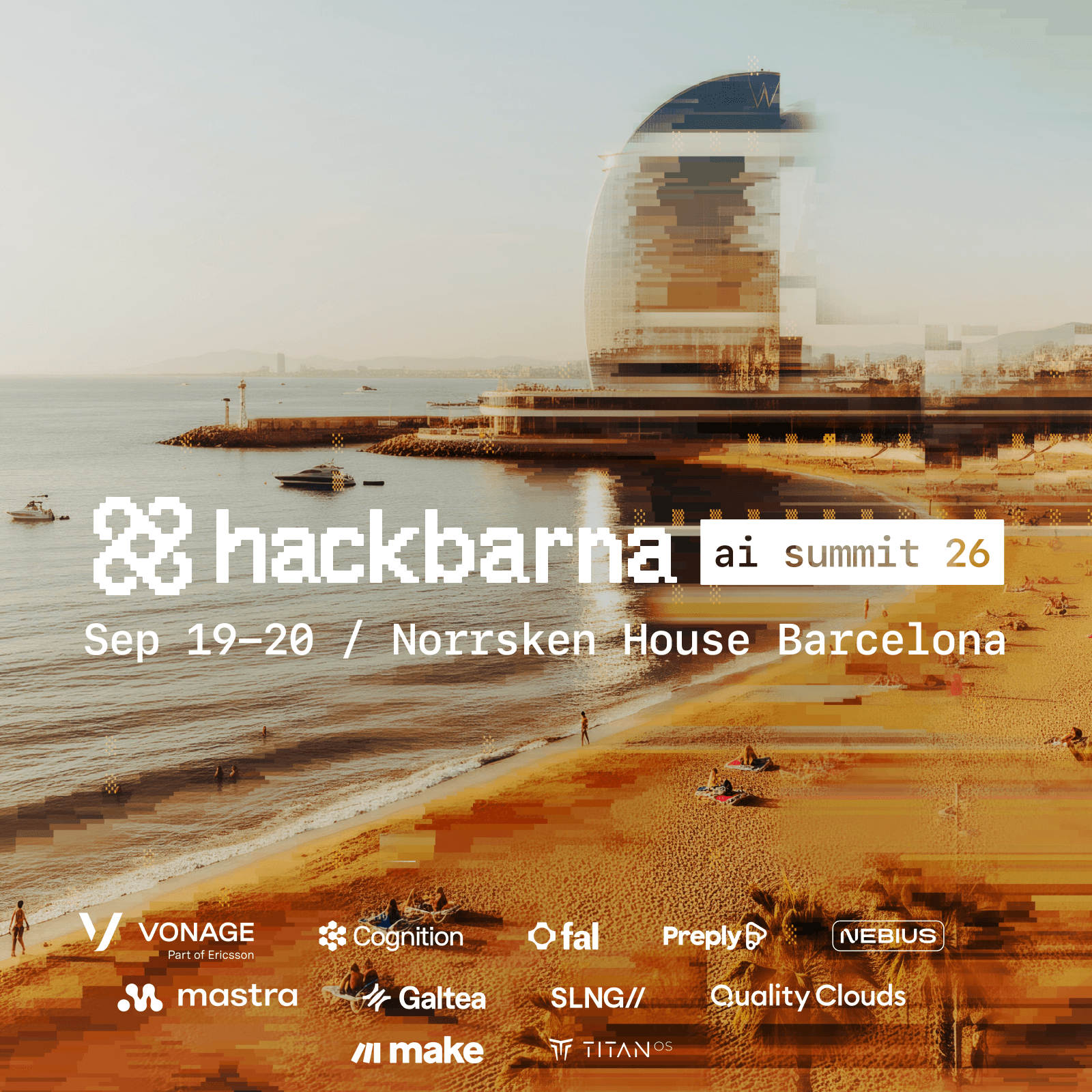
The third edition of HackBarna is coming, co-organized with AI Summit Barcelona 2026. Join 150 hackers at Norrsken House Barcelona for a weekend of hacking, workshops, and demos.
Partners
 Co-organizer
 Venue
Sponsors
Gold

Silver










Community partners

Défis
AI agent for content recommendation on TVs
Finding something to watch on a TV is still hard. Build an AI agent that helps viewers decide what to watch through natural conversation.
Requirements
- A working prototype of a conversational agent that recommends movies, shows, or live TV.
- The user interacts through dialogue: natural language requests and follow-up questions (e.g. "something light for a Friday night" → "do you want a movie or a series?").
- Designed for the TV: remote or voice input, usable from the couch.
- Any public catalog or metadata source is fine (e.g. TMDB).
What a strong submission looks like
- A working end-to-end demo, even with mock data.
- A real conversation: the agent asks clarifying questions and refines its suggestions — not just one prompt, one answer.
- A UX that works on a TV screen, not a mobile chat app.
🏆 A Philips Ambilight 43" TV for each team member
Build, adapt and ship with Nebius Token Factory
Build or improve an AI product that solves a meaningful problem using Nebius Token Factory. Teams can build an application or agent, connect models to data and tools, compare or evaluate models, optimize an existing workflow, or use supported Data Lab and model customization capabilities where available. Teams may combine Token Factory with any other HackBarna sponsor or developer tool, but no additional integration is mandatory.
Requirements
- Token Factory must be used meaningfully in the working project.
- Its use should contribute directly to the product's core functionality or demonstrate a measurable improvement in quality, grounding, evaluation, speed, cost or reliability.
Resources
🏆 $1,000 for 1st · $500 for 2nd · $100 for 3rd
Devin for X — Building the Autonomous Layer
Devin does software engineering autonomously because software has a feedback loop — write, run, test, fix. Your job is to find a domain with that same structure and build the layer that puts Devin to work inside it through the Devin API. Build a system where the inputs go beyond chat. It programmatically triggers Devin sessions, gives them a way to check their own work, and produces real artifacts with little or no human in the loop. Devin already has the hands — a shell, a browser, a machine. You supply the standard it has to meet. Devin proposes; your layer authorizes, and sometimes refuses. Build for consumers or enterprise — the more the output is something a user can see, play, hold, or use, the better it demos.
Examples
- Games: Devin rewrites the game while you play; the change ships only if the build passes and the game still runs.
- Hardware (consumer): Devin designs the PCB from a spec; DRC, ERC, and SPICE decide whether it's real.
- Physical AI (enterprise): Devin plans the shelf layout and robot route; your layer recomputes the physics and economics before dispatching.
- Startup factory (enterprise): Devin scopes and builds the product; a browser test completing the checkout is the only definition of done.
Requirements
- Devin sessions are created and driven through the API, not the web UI.
- Something in your code decides whether each output passes — a test suite, a simulator, a solver, or a validator. Not a person, and not a model saying it looks good.
- Failures go back to Devin and it tries again. Show us a run where the first attempt was wrong and the system fixed it on its own.
Judging criteria
- Autonomy: external trigger, little or no human in the loop, and it demonstrably recovers from its own failures.
- Guardrails: verifies independently, and correctly refuses or escalates work that shouldn't ship.
- The product: a real problem and a functional artifact at the end — deployed, executable, or physically actionable. Would someone actually use this?
- Orchestration: creative use of the API, and complexity that earns its place — fan-out, adversarial checks, learning across runs.
🏆 A 6-month Devin Max subscription for each team member
Best use of the Vonage Video API
Build something awesome with real-time video. Use the Vonage Video API to create an innovative app that solves a real problem — in any industry, for any audience.
Ideas to get you started
- A video bot that verifies user identity with AI.
- A video call with live speech translation.
- A telehealth app with live captions and call summaries.
- A virtual classroom with automated meeting notes.
- An immersive AR/VR video experience.
What you can use
- The Vonage Video API supports real-time video, screen sharing, recording, live captions, background effects, AI audio pipelines, and more — across Web, iOS, Android, and React Native.
Judging criteria
- Functionality: does it work and meet its intended purpose?
- Creativity: is the idea original, imaginative, and fun?
- Use of Vonage Video API: how effectively and deeply is the API integrated?
- User Experience: is the interface intuitive and well-designed?
- Impact & Potential: does it solve a real problem, and could it grow into something bigger?
- Each area is scored out of 5; the highest overall score wins.
🏆 A Corsair Void v2 Wireless headset for each winning team member (max 3) · a t-shirt for every team that uses the Vonage Video API
Build an infinite livestream app using H3 Max Director
Build a livestream app powered by MiniMax H3 Max Director on fal. Director generates video in real time and lets your app steer it as it streams. Build something creative on top of that — we are not suggesting use cases on purpose. Surprise us.
Requirements
- Use MiniMax H3 Max Director via the fal API as the core of your app. You can combine it with any other fal models or external services.
- The video must be generated live by your app, not pre-rendered.
- The output must be viewable in a browser or app.
What a strong submission looks like
- A public GitHub repo with a README explaining what the app does and how it uses H3 Max Director.
- A short demo video showing the stream running.
- A clear creative concept, and a use of Director that a simple text-to-video call couldn't achieve.
Resources
🏆 $1,000 in fal credits
Best use of the SLNG platform
SLNG is the execution layer for voice AI. Drop in its speech-to-text and text-to-speech APIs on their own, or run a whole voice agent on top. Own what you build and run it anywhere, across models, providers, and regions, without giving up control. Keep your orchestrator and models, add SLNG underneath. Cleaner audio in, fewer LLM calls, faster speech out, across 15 sovereign regions. 53% less LLM cost, 39% less turn latency.
Requirements
- Use SLNG at the core of your project, whether that's the speech-to-text API, the text-to-speech API, or a full voice agent on top.
- Show what you built and where SLNG fits in your stack.
- Bring any orchestrator, models, or providers you like. SLNG sits underneath.
Bonus points
- Extra points for building on the unmute framework. Show what you made with it and how.
What a strong submission looks like
- A voice agent that actually runs, live or recorded.
- A clear walkthrough of how SLNG (and unmute, if you used it) makes it work.
- Real numbers where you have them, like latency, cost, and audio quality before and after.
Resources
🏆 A LEGO set for each winning team member
Find your AI's worst flaw and prove you can fix it
Point Galtea at whatever you built — a chatbot, a RAG app, a voice agent, or a tool-using system. Describe what it should do in one line, then let Galtea generate adversarial inputs, test behaviour outside your product's intended scope, and evaluate the results.
Your mission
- Find: uncover a failure that could matter to a real user.
- Fix: change your product to address the cause.
- Prove: re-run the evaluation and show the before-and-after results.
Judging criteria
- Impact: would a real user encounter this failure, and what would it cost them?
- Discovery: did your tests uncover a problem you didn't know existed?
- Fix: did you fix it? Show the failing case, explain the change, and share your rerun's results.
- To qualify for the prize, complete the product feedback survey. Positive or critical, it will not affect your score.
🏆 3 LEGO sets (Game Boy, Pixar Lamp, Polaroid), 3 Galtea T-shirts, and a free 3-month Galtea Pro subscription for the winning team
Production Ready: ship AI code you can defend
Build anything you want — any idea, any stack, any AI tools. Norma is not a constraint on what you build; it is the layer you use to improve your project and defend it in front of the judges. Show the judges a verdict, not a vibe.
Setup (pick either or both)
- All through MCP: connect the Norma MCP server to Claude, Cursor, or VS Code, then scan, fix, and rescan without leaving the agent.
- Full Scan on repo: connect GitHub, run a Full Scan, fix, and rescan.
Requirements
- One scan, at least one fix, and one rescan.
Judging criteria
- Final Production-Ready Score.
- Issues found and fixed during the event (audit-trail delta).
- A two-minute "defend your code" talk covering one finding you fixed and one you consciously accepted.
🏆 A Keychron V6 8K mechanical keyboard (ISO-ES) for each winning team member, plus 12 months of Norma Pro
Build an agent people can message
Build a Mastra agent and put it on a messaging platform people already use — Telegram, Discord, Slack, WhatsApp, Teams, or iMessage. A remote Mastra judge will message your agent cold, from their own phone, with no walkthrough. Nobody watches a demo; they text it. A chatbot that answers questions is the floor — your agent has to do at least one thing a plain LLM wrapper can't.
Go beyond a wrapper (do at least one)
- Remember: it knows who it's talking to and what they said yesterday, using Mastra memory.
- Act: it calls tools that change something in the world, and asks for approval in the chat before anything risky (requireApproval renders Approve / Deny cards in the channel).
- Run a process: a multi-step workflow that pauses for a human and resumes later.
- Message first: a schedule or background task means it reaches out to the user, not just the other way round.
Rules
- Built on Mastra (@mastra/core), with any model provider through the model router. Nebius Token Factory counts, so one project can enter this and the Nebius challenge.
- Reachable on at least one real messaging platform through Mastra Channels.
- Does at least one of the four things above.
- A public repo with a README that gets a stranger from clone to first message. This also satisfies the Cognition open-source challenge.
- Built during the event. Existing ideas are fine, existing code is not.
- Submit by the Sunday 2:00 PM code freeze — bot handle or invite link, repo URL, a 60-second recording of a real conversation, and one line on who it's for.
- Keep the bot live until 17:30 Sunday; the remote judge messages it in the afternoon.
Judging criteria
- Works from a stranger's phone (30 points): responds in reasonable time, stays coherent, and handles a message it wasn't built for.
- More than a wrapper (30 points): remove the memory, tools, workflow, or schedule — does the product collapse?
- Someone would keep it (20 points): a clear user and a clear problem. Would the judge leave the bot in their contacts?
- Craft (20 points): readable agent instructions, tool schemas that make sense, and a README that works.
- Tie-break: whichever bot is still answering when the judge checks again at 17:00.
Resources
- Quickstart: run npm create mastra@latest
- Docs
- Channels
- Telegram setup
- Discord setup
- Memory
- Harness (schedules, background tasks, durable agents)
- Templates
- GitHub
🏆 €250 to the winning team
Best use of AI for Learning
Build something that helps a user learn — languages, coding, music, anything. Preply is the human-led, AI-enabled language-learning platform connecting learners in 180 countries with 150,000+ tutors across 90+ languages.
Judging criteria
- Effectiveness: is there any signal of progress?
- Engagement: would you come back tomorrow?
- User experience: how polished and intuitive the whole flow feels.
- Creativity: an original use of AI, not another chat wrapper.
🏆 $500 in Preply lesson credits for each winning team member (about six months of weekly one-on-one lessons with a tutor in any language or subject)
AI for Wildfire: detect, track, and predict wildfires from real-time data
Spain just had a record-breaking wildfire year. We are drowning in data — satellites, cameras, weather stations — but the hard part is pulling accurate, actionable signal out of it in real time. Build something that does exactly that.
Pick one of four tracks
- Early detection: train a model that accurately detects wildfires from cameras, satellites, or other feeds, so firefighters are alerted as early as possible.
- Monitoring active fires: draw real-time perimeters of active fires from satellite data, determine the direction they are spreading, and simulate their movement.
- Prediction: identify where and when fire risk is highest by analyzing weather data for high-risk conditions and days.
- Values at risk: build an agentic system that identifies the infrastructure, people, and assets in danger when a fire breaks out, and helps make evacuation calls (which hospital, which school, etc.).
What a strong submission looks like
- Works on real data from the provided resources.
- Produces results in, or near, real time.
- Clearly shows how a firefighter or emergency coordinator would actually use it.
Judging criteria
- Using AI to actually help first responders do their jobs better.
- Technical implementation and accuracy on real data.
- Creative use of the provided datasets and APIs.
- Demo quality.
Resources
🏆 First place: a 3-month Norrsken House membership per team member. Second and third place: 10 Norrsken day passes per team.
Prix
- Unique trophy
- 3 gold tickets to the AI Summit conference (€655 value each)
- Pitch at the AI Summit startup competition in front of investors
- MacBook and AirPods by fleet.co
- Mentorship session with Pedro from Bynd.vc
- $1,000 in Nebius credits
- A 6-month Devin Max subscription
- Thousands of tokens and credits
- Unique trophy
- 3 silver tickets (€355 value each)
- A 4-month Devin Max subscription
- Tokens and credits
- Unique trophy
- 3 silver tickets (€355 value each)
- A 2-month Devin Max subscription
- Tokens and credits
Community voices
What people are saying


 Pedro Gil
Associate @ Bynd VC
 Dani Carmona
CEO @ Supersonik
 Lilibeth Bustos Linares
CEO & Founder @ SOMA AI
 Carmen Ansio
Design Systems @ Stripe
 Louis Cameron Booth
Founder @ Deepfire
 Guillermo Llopis
CTO @ SOMA AI
 Jonne Frankena
Account Executive @ Kapa.ai (YC S23)
 Baptiste Jacquemet
Founder @ Agent Studio
 Manuela Mejia Tobar
Communication Lead @ Norrsken
 Gerard Pijoan
Head of Design @ Titan OS
 Garazi Marques
HR Director @ Titan OS
 David Villanueva
VP of Ad-Tech and Data @ Titan OS
 Miquel Barba
CTO @ Titan OS
 Dylan Bristot
Founding PMM @ Nebius
 Mashrur Haider
Founding Tech PM @ Nebius
 Ismael Ordaz
Co-founder @ SLNG
 Tolga Yapici
AI Engineer @ SLNG
 Francisco Javier
ML Engineer @ SLNG
 Dwane Hemmings
Developer Advocate @ Vonage
 Julia Biro
Developer Advocate @ Vonage
 Jorge Ortiz
Developer Advocate @ Vonage
 Lucinda Abberley
Global Community Manager @ Vonage
 Mehmet Koseoglu
Principal / Staff Applied AI Scientist @ Preply
 Sahar Mbarek
Senior Applied Scientist @ Preply
 Casimiro Pio C
Senior Applied AI Scientist @ Preply
 Peter Loboda
Senior Engineering Director @ Preply
 Umut Günbak
European Operations & Startups @ fal
 Alper Bahçekapılı
Applied MLE @ fal
 Zakee Abdi
Developer Advocate @ Cognition
 Baybars Külebi
CTO & Co-founder @ Galtea
 Luca Galvani
Founding Marketer @ Galtea
 Guillem Poy
Founding Software Engineer @ Galtea
 Sonia Toqqe
Event Marketing Manager @ Make
 Ignacio Sales
CTO @ Quality Clouds
 Cristian Urraca
VP of Engineering @ Quality Clouds
 Nuno Silva
Engineer @ Quality Clouds
 Yasmina Ajouau
Mentor @ Quality Clouds
 Albert Franquesa
CSO @ Quality Clouds